Optimizing rear clearance: Tail lifts mounted under the vehicle body
Bär Cargolift offers specialized under-vehicle and foldable tail lifts for operations where the loading aid is used intermittently or must not obstruct loading ramps. These systems eliminate the rear-vehicle protrusion found in Standard platforms, reducing the risk of collision during ramp maneuvers. This guide details the functionality and applications of RetFalt, Ret/HydFalt, and Falt systems:
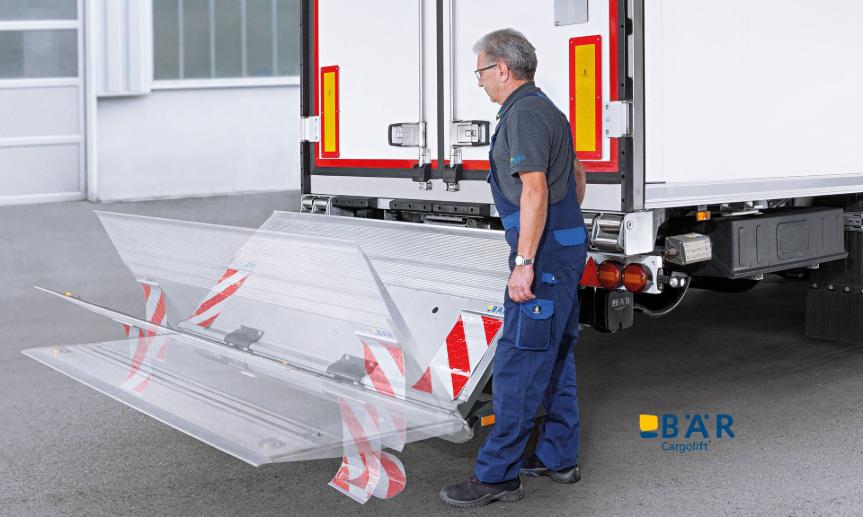
Bär RetFalt: Efficient retractable tail lifts with single-folded platforms
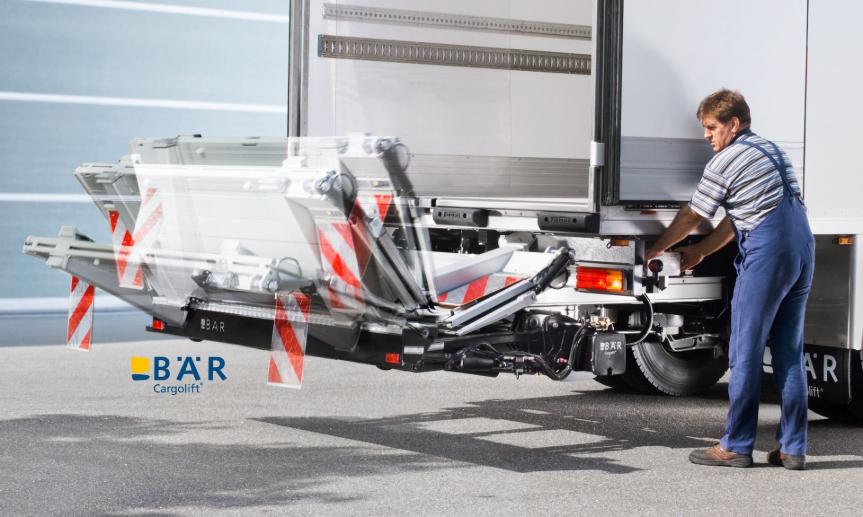
The Bär RetFalt Cargolift is a retractable tailgate that retracts completely under the vehicle body during transit. This design allows vehicles to approach loading ramps without moving the lift, optimizing loading speed. The system utilizes a hydraulic sliding mechanism (guide rail) and a sliding cylinder for extension, while the platform is folded once manually using a spring-relief system.
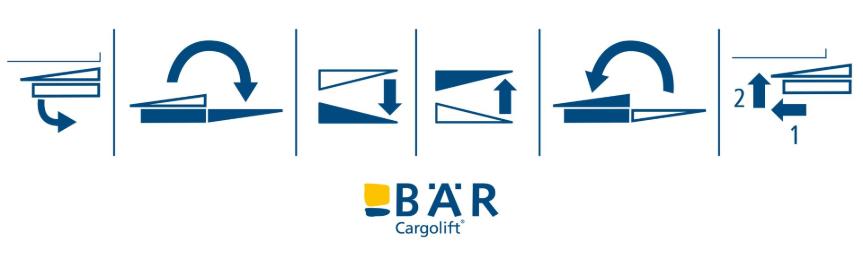
RetFalt operation: Hydraulic extension & manual unfolding
For operation, the platform package is extended hydraulically via the operating element - for example the Bär Control EVO operating unit. The aluminium platform is then unfolded by hand. The lift is now ready for use and the platform can be loaded. When the platform is raised and lowered, it automatically tilts up and down on the ground. After loading/unloading, the platform is folded back in by hand before the platform package is retracted - this means pulled back under the vehicle body - and raised.
If there is little space at the rear of the vehicle, it is possible that the platform must be extended further for folding than for operating. In this case, BÄR refers to this as an additional working position. More specifically; the platform package is extended as far as possible, the platform is unfolded manually and then retracted again slightly. The platform stops automatically at a sensor that signals to the operator the correct position for use when the platform is unfolded. After the lift has been used, the platform is fully extended again, folded up and then retracted hydraulically under the vehicle.
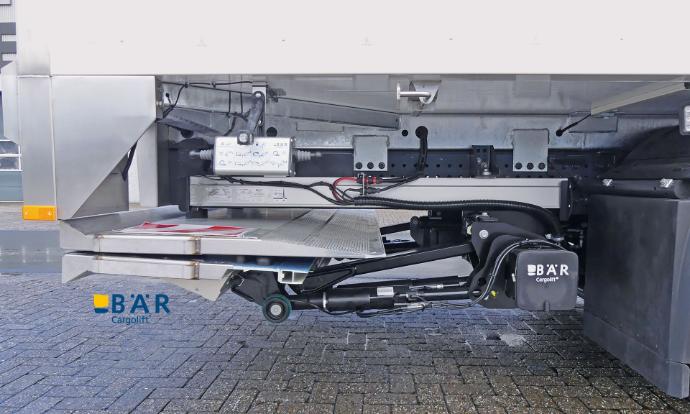
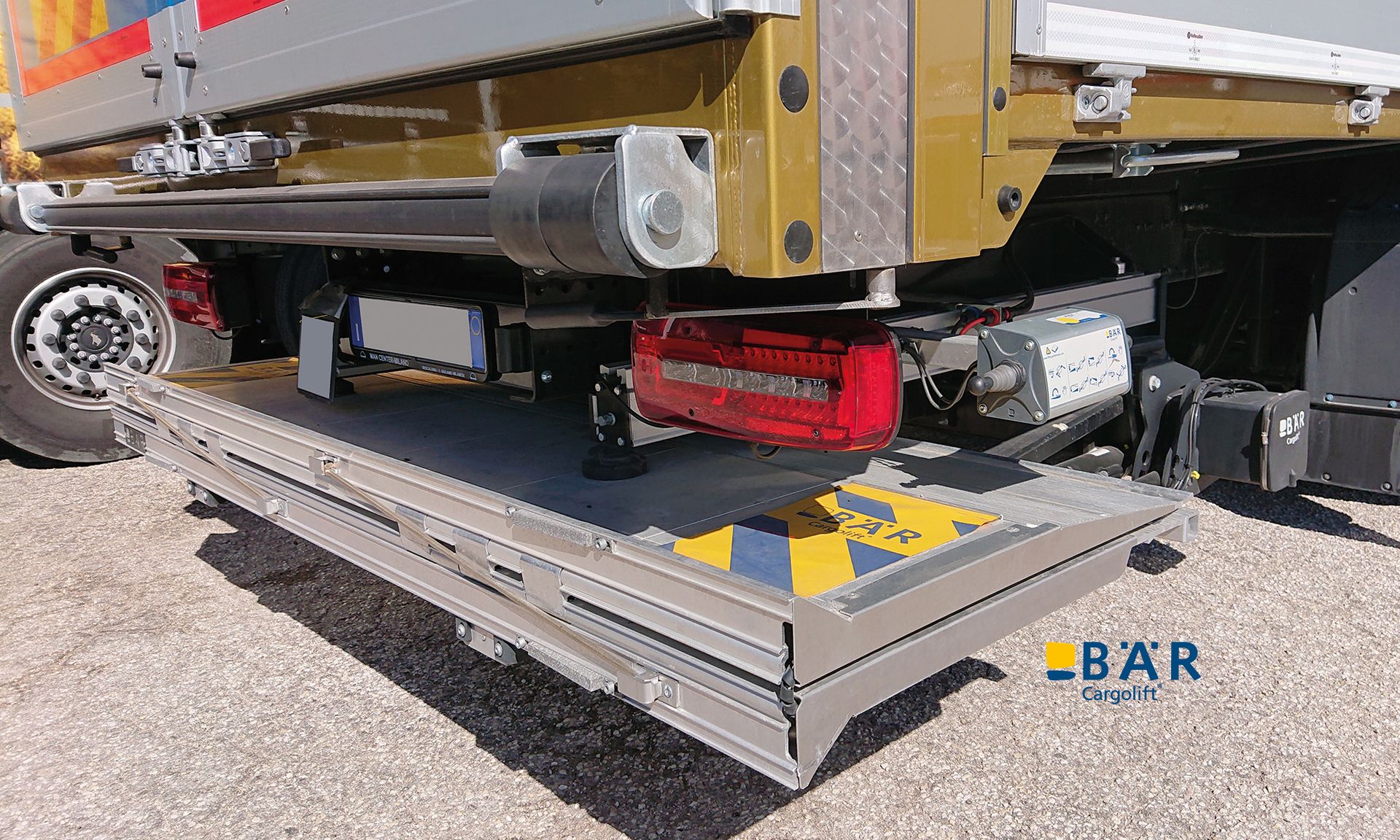
RetFalt use cases: Long-distance transport & specialized cargo
Retractable systems like the RetFalt are optimal for long-distance transport where loading ramps are unavailable at customer premises. This system is specifically designed for transporting protruding materials and allows rear forklift loading without risking damage to the lift, as the platform remains protected under the chassis. Use of protected retractable lifts reduces maintenance-related downtime compared to exposed platforms.
BÄR differentiates the RetFalt Cargolifts with single-fold platform according to the carrier vehicle.
» Retractable tailgates for mounting on trucks
RetFalt Cargolifts for mounting on lorries are:
- BC 1500 R21
- BC 1500 R4U
- BC 2000 R41
- BC 2000 R4U
- BC 2500 R41
- BC 3000 R41
» Retractable tailgates for fitting to semi-trailers
The RetFalt product group includes the following Cargolifts for mounting on semi-trailers:
- BC 2000 R2T
- BC 2000 R4C
- BC 2000 R4K
- BC 2000 R4T
- BC 2500 R4C
- BC 2500 R4K
- BC 2500 R4T
Wondering what this abbreviation means? In a nutshell:
BC stands for ‘Bär Cargolift’, followed by the load capacity (e.g. 2000 kg), R means RetFalt (retractable - can be driven under with the platform one time folded by hand), 4 indicates four cylinders, the letter after that indicates a special technical feature. Further information can be found in the article on the Bär Cargolift type code.
Bär Ret/HydFalt: Compact double-folded lifts for minimal overhang
Just like the RetFalt product group, the Cargolifts of the Ret/HydFalt product group are located under the carrier vehicle during the drive. The folded platform extends horizontally with the aid of a sliding cylinder and a guide rail. The platform of these lifts is folded twice - either manually (BÄR then refers to this as RetFalt) or hydraulically using the control unit. BÄR refers to the hydraulic platform folding as HydFalt.
Ret/HydFalt systems provide a more compact footprint than RetFalt models, reducing the required rear vehicle overhang. This increased compactness is critical for chassis manufacturers optimizing vehicle length. While offering a space advantage, the double-folding mechanism requires an additional manual or hydraulic step during deployment compared to single-fold systems.
Ret/HydFalt technical operation: Retractable, double-fold logic
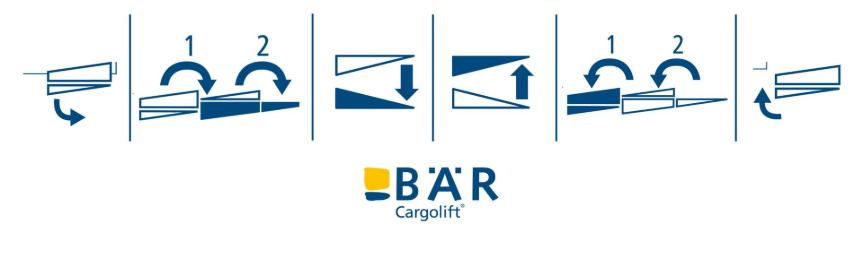
As with RetFalt, the platform package of Ret/HydFalt Cargolifts is extended hydraulically via the operating element - for example the Bär Control EVO operating unit. The platform is then unfolded in two steps, either manually with spring support (RetFalt) or hydraulically (HydFalt) Depending on the fitment situation, it may be necessary to return the unfolded platform to the working position - meaning to move closer to the vehicle in order to be able to reach the loading floor (additional working position - see RetFalt function above).
The control element can be used to lift the unfolded platform to the loading floor or lower it to the road. On the ground, the platform automatically tilts up and down. After loading/unloading, the platform is fully extended, then folded in - manually (RetFalt) or hydraulically (HydFalt) – before the platform package is pulled under the vehicle body and automatically lifted. This braces the Cargolift in the travelling position.
Ret/HydFalt integration: BDF swap systems & short overhangs
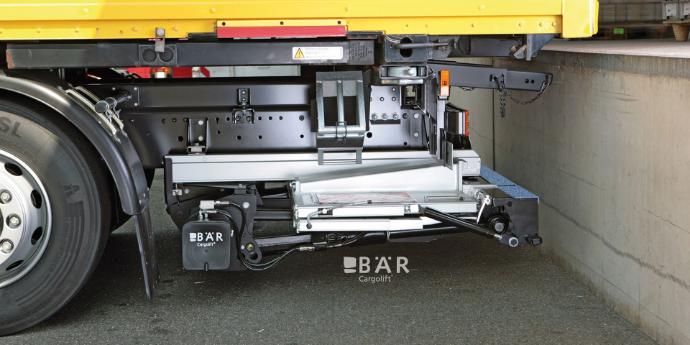
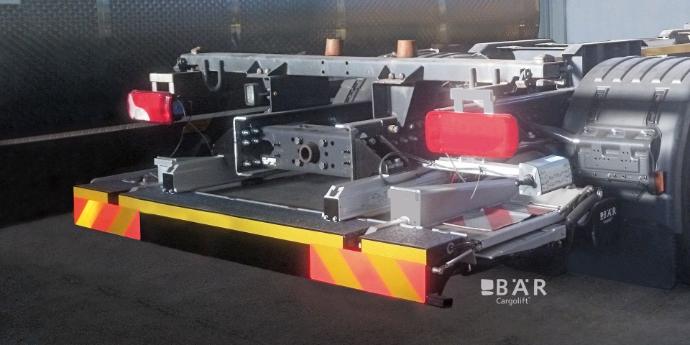
Ret/HydFalt systems are engineered for short-overhang vehicles and BDF swap systems. In compliance with EN 284, the guiding rail integrates sensors and an intelligent control system that automates positioning across varying swap body lengths. To ensure safety during the transition between different body lengths, the system employs two support arm stops and a folding bridge.
The product group Ret/HydFalt includes the following Cargolifts:
- BC 1500 R42 with double hand-folded platform
- BC 2000 R42 with double hand-folded platform
- BC 1500 H42 with double hydraulically folded platform
- BC 2000 H42 with double hydraulically folded platform
What does the product name say? In short:
BC stands for ‘Bär Cargolift’, followed by the load capacity (e.g. 2000 kg), R means RetFalt (an be driven or slided under with manually folded platform), while H stands for HydFalt (can be driven under with hydraulically folded platform), 4 indicates four cylinders, the following 2 indicates double platform folding. Further information can be found in the article on the Bär Cargolift type code.
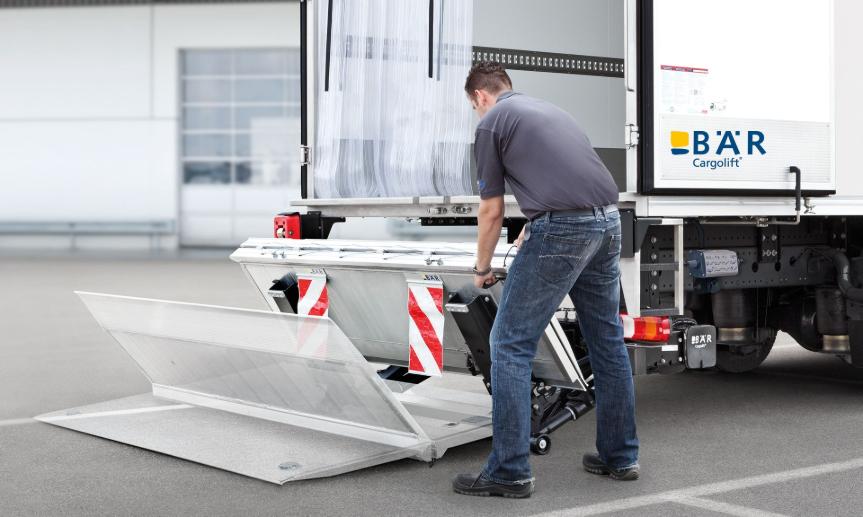
Bär Falt: Compact tuck-away lifts for occasional loading
The Bär Cargolift Falt is a tuck-away lift positioned diagonally under the body floor in the driving position. It is the primary choice for vehicles requiring infrequent loading assistance. When in use, the platform is folded twice manually with spring support.
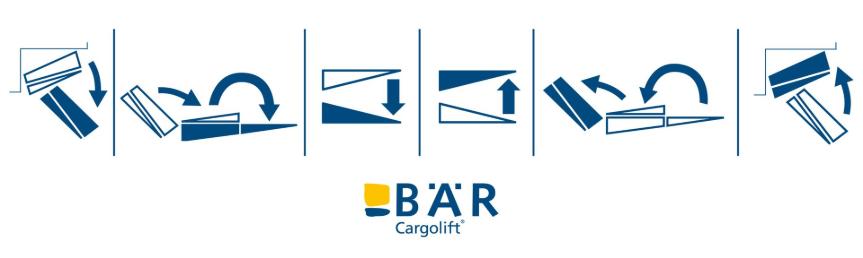
Falt operation: Diagonal storage & manual unfolding
The operator first lowers the platform via the control unit (e.g., Bär Control EVO) and unfolds it twice. The platform automatically tilts on contact with the ground. After use, the sections are folded manually, and the entire platform is lifted to the diagonal travelling position.
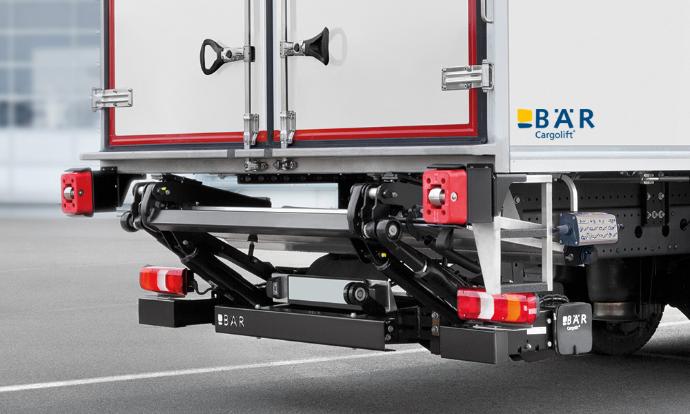
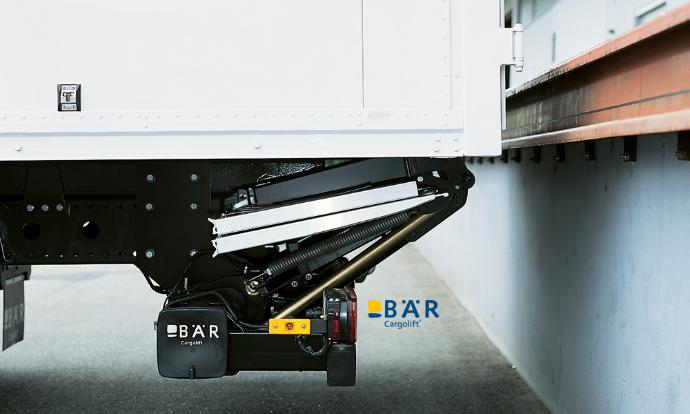
Falt application: Occasional load needs & tilt levelling
Falt Cargolifts are utilized for low-frequency loading needs. For uneven terrain, the F4 version features "inclination equalisation" via two inclination cylinders, ensuring a level platform at all heights to prevent load shifting.
They are available in two versions: If the platform inclination is to be adjustable in all height levels, the F4 version offers so-called inclination equalisation or tilt levelling using two inclination cylinders.
BÄR offers the following Cargolifts in the product group Falt:
- BC 1000 F2
- BC 1000 F4
- BC 1500 F2
- BC 1500 F4
- BC 2000 F2
- BC 2000 F4
What does the product name mean? In a nutshell:
BC stands for ‘Bär Cargolift’, followed by the load capacity (e.g. 1500 kg), F means Falt (tuck-away, can be folded under), 4 indicates four cylinders. You can find more information in the article on the Bär Cargolift type code.
Summary& frequently asked questions (Q&A)
This overview of Bär Cargolift types provides the foundation for selecting the correct system based on vehicle overhang, usage frequency, and loading environment. For further details on load capacities and fitment, visit the Tail Lift Lexicon.
The tail lift lexicon deals with the following questions:
Under-vehicle taillifts are stowed beneath the vehicle chassis, allowing for unobstructed access to the rear doors for dock loading without deploying the lift. This design protects the platform from environmental influences and provides maximum flexibility for multi-drop operations. This versatility is a hallmark of the engineering found in Bar Cargolift tailgates.
The Ret/HydFalt features a double-folded platform rather than a single fold, resulting in a more compact footprint and reduced rear vehicle overhang. This is particularly important for chassis manufacturers who need to optimize overall vehicle length without sacrificing tail lift load capacity. The hydraulic variant (HydFalt) automates both fold steps via the control unit, simplifying operation. Bar Cargolift Ret/HydFalt systems are available in both manual and fully hydraulic versions to match different vehicle integration requirements.
Unlike the RetFalt, which slides horizontally under the vehicle body, the Falt is stored diagonally beneath the body floor in its travelling position. It is designed primarily for vehicles with infrequent loading requirements and features a fully manual double-fold deployment with spring support. The simpler mechanism makes it a cost-effective choice for operations that do not require daily lift use — and Bar Cargolift Falt models are available in load capacities from 1,000 kg to 2,000 kg to cover a different commercial vehicle applications.
Die Falt-Baureihe umfasst sechs Modelle mit 1.000 bis 2.000 kg Tragkraft. Die F4-Variante hat zwei Neigezylinder für den Neigungsausgleich (Tilt Levelling). So lässt sich die Plattform in jeder Höhe neigen, etwa am Hang. Die F2-Variante ohne diese Funktion eignet sich für ebenes Gelände.
Yes, they are ideal for reefers because they allow the rear doors to stay closed or be backed directly into a cold-store dock seal without the lift being in the way. This helps maintain the cold chain integrity by minimizing temperature loss during loading. Thermal efficiency in transport logistics is effectively supported by Bar Cargolift taillifts. Find out more about vehicle specific taillift equipment in this lexicon.
All under-vehicle lifts are certified to function as the official underrun protection, provided they meet specific structural and height regulations when in the stowed position. This dual functionality saves weight and reduces the overall complexity of the vehicle body. The certificates can be downloaded on this website. Innovative and compliant safety solutions are integral to Bar Cargolift tail lifts.