Choosing the right tail lift is an important milestone for any transport company. It is more than just an aid - it is the link between vehicle and goods handling that determines the efficiency of your daily work. As a manufacturer of tail lifts, BÄR would like to support you in choosing the suitable Cargolift.
In the previous article on carrier vehicles, you have already realised that all Bär Cargolifts have been developed for specific carrier vehicles. After all, the Bär Cargolift should fit your commercial vehicle perfectly - regardless of whether you drive a panel van or a 40-tonne truck.
In the MyCargolift product recommandation, your carrier vehicle is therefore the basis for the Cargolift selection. Once you have selected your vehicle, you decide on the desired tail lift system (see article Different types of tail lifts). With the information about your load and the desired platform dimensions, the MyCargolift product finder determines the right Cargolift for your requirements based on the maximum load capacity, the load moment and the available platform heights of the corresponding Bär Cargolift.
Try it out for yourself:
If you would like to get a more detailed insight in advance, you will find three examples of the use of MyCargolift below.
Example I: Vegetable trolleys are to be delivered to the weekly market in a light lorry
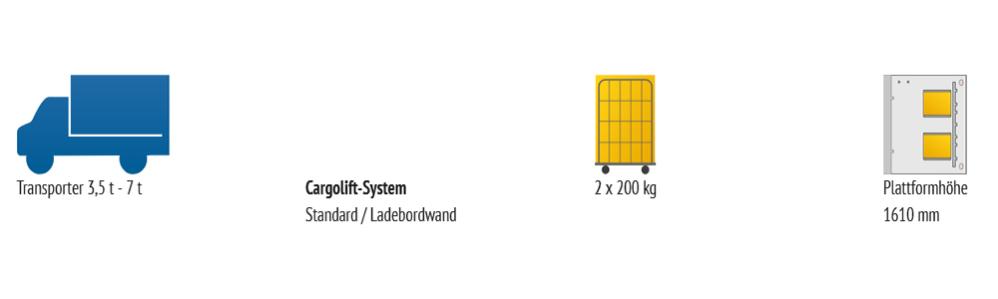
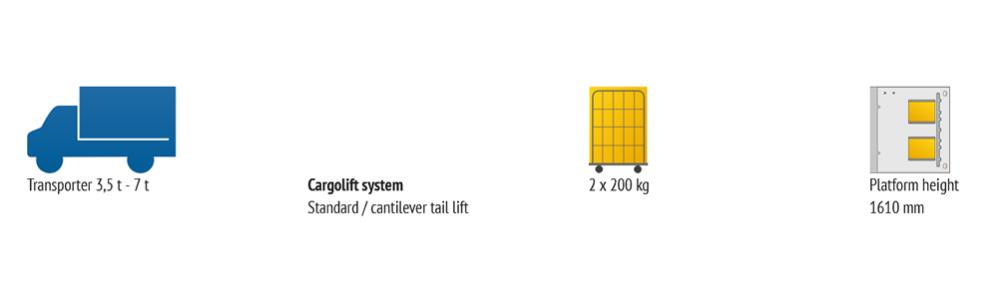
In example I, at first
- the van is selected,
- then the platform behind the body (Standard Cargolift).
- The platform is loaded with a maximum of two trolleys per loading process,
- whereby one roller container weighs up to 200 kg.
- The required platform height is 1,610 mm.
The following appears as a suggestion with a link to the product data sheet and information on available equipment:
BC 750 S2L as a payload-optimised tail lift
Alternatively:
BC 750 S2S with high load distance if pallets are also occasionally loaded
BC 750 S4 if a ball coupling is required for trailer operation
Example II: As many food roll containers as possible need to be unloaded as quickly as possible at the rural supermarket
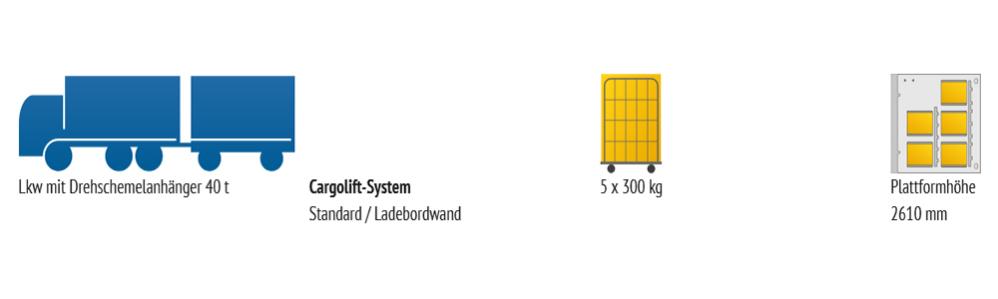
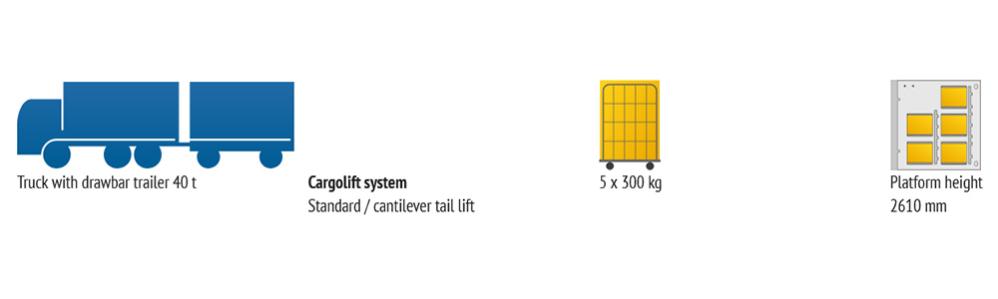
Example II starts with a typical food logistics requirement:
- An articulated lorry is used as the vehicle - thus a lorry with a trailer.
- The large platform of the Standard Cargolift serves as an advertising space.
- Up to five roll containers are to be unloaded simultaneously at the unloading point
- with one roll container weighing up to 300 kg.
- The desired platform height is 2,610 mm.
The product recommendation appears with a link to the product data sheet and information on available equipment:
BC 2000 S4 as the Standard Cargolift for food logistics
Alternatively:
BC 2000 S4V with variably positionable underrun bar
Example III: Pallets of concrete are to be delivered to their destination after a long journey in the semi-trailer
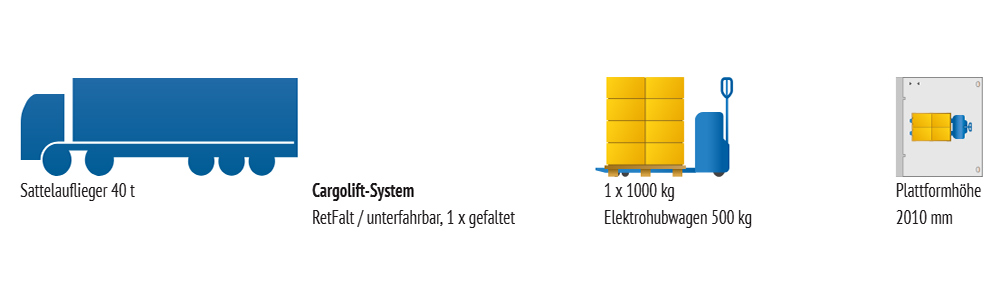
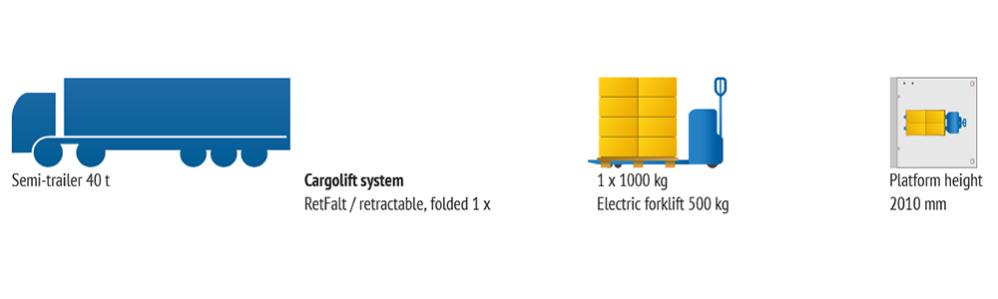
In example III, the requirement comes from long-distance transport:
- From the semi-trailer
- pallets with an individual weight of 1,000 kg
- are to be unloaded on a 2,010 mm deep platform
- with the aid of an electric pallet truck (approx. 500 kg!)
- using a retractable lift (RetFalt Cargolift).
MyCargolift suggests with a link to the product data sheet and information on available equipment:
BC 2000 R4T with high load moment
Alternatively:
BC 2500 R4T with even more load capacity
Instructions for use
Your requirements are at the centre of MyCargolift. In MyCargolift, BÄR combines its portfolio information with your requirements for carrier vehicle, lift system, load capacity and platform height. If you usually unload light goods, but occasionally need to load a heavy pallet, BÄR recommends that you enter the maximum requirement in MyCargolift. This is because overloading can have serious consequences (see article on load capacity).
Try it out for yourself:
The alternative to MyCargolift: The BÄR sales team


Of course, the BÄR sales team is also available to provide purchasing advice. Find your contact person here »
Because the BÄR range does not end with the matching Cargolift. Are you transporting roll containers? Then you need a roll-off protection system / roll-stop. Do you have questions about operation? BÄR offers various operating elements such as the Bär Control EVO operating unit or the Bär SmartControl radio remote control. Would you also like to integrate the Cargolift digitally into your fleet management system? Bär Cargolift offers a standardised data interface. Further details on Cargolift equipment can be found in further encyclopaedia articles.
Summary & frequently asked questions (FAQ)
Carefully analysing your loading situation pays off: The matching Bär Cargolift optimises your work processes, protects the load and increases the safety of your employees and the surrounding area. It is therefore an investment in the future of your company.
Do you already know which Cargolift you would like to use? Then it is advisable to check the exact mounting situation in order to optimally adapt the Cargolift to the vehicle. BÄR offers the fitment analysis program » for this purpose.
And don't worry, more lexicon articles are in the pipeline! Stay interested!
The suitable taillift depends on several factors, including the type of carrier vehicle, the weight of the goods, the required platform size, and the intended loading process. A proper evaluation of these requirements ensures safe and efficient goods handling while avoiding overloading or operational limitations. For professional vehicle applications, Bar Cargolift tail lifts are available in configurations matched to different vehicle types and transport tasks.
The carrier vehicle determines which tail lift systems can be installed and operated safely. Different solutions are designed for panel vans, transport chassis, rigid trucks, articulated vehicles, and semi-trailers. Selecting a tail lift that is specifically engineered for the vehicle improves performance, durability, and operational safety. Bar Cargolift tail lifts are designed to match a wide range of commercial vehicles.
The most reliable starting point is the carrier vehicle type,
combined with the customer's load requirements,
and platform size specifications.
MyCargolift works through these parameters systematically and outputs the correct model with a direct link to the product data sheet.
For the subsequent installation phase, it is essential to verify the mounting situation precisely — including rear overhang and available space — using the fitment calculation programme to avoid fitment errors.
Bar Cargolift tail lifts are designed for demanding transport operations and optimized in efficient fitment processes.
BÄR recommends always entering the maximum expected load into the selection tool MyCargolift — even if heavy loads are the exception rather than the rule. A tail lift that is undersized for peak loads creates safety risks and can lead to equipment damage. Once the right model is identified, you can then verify the exact mounting situation for each vehicle. Use the fitment calculation programme to confirm that your chosen Bar Cargolift integrates correctly with each vehicle in your fleet.
The load moment describes the relationship between load weight and distance from the lifting mechanism. Even when a load is within the nominal capacity, a long load distance can require a stronger tail lift. Understanding the load moment helps prevent unsafe operating conditions. The product finder MyCargolift takes this into consideration. Bar Cargolift tail lifts are engineered with different load moment capacities for specific applications.