Product name ‘BC 2000 S4A’ - Classification and meaning
As a manufacturer of tail lifts, BÄR wanted to have a systematic product name right from the start. In the beginning - in 1981 - there were product names with ‘BLW’ as an abbreviation for ‘BÄR Ladebordwand’ (German for Cantilever lift). Since 1992, the brand has been called ‘Bär Cargolift’. With the new brand name, BÄR has developed a standardised nomenclature for its products - the Cargolifts - known internally as the ‘BÄR type code’. These product names describe the key technical and design features of each lift model. So take a look behind the product names!

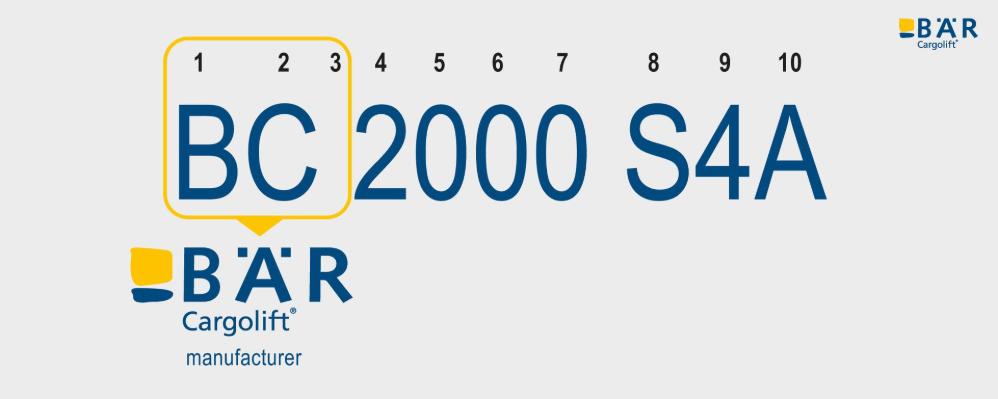
Position 1 + 2: BC – Manufacturer identification
‘BC’ stands for Bär Cargolift, the manufacturer of the tail lift. This abbreviation is part of all of the company's model designations and is used to clearly identify the producer.
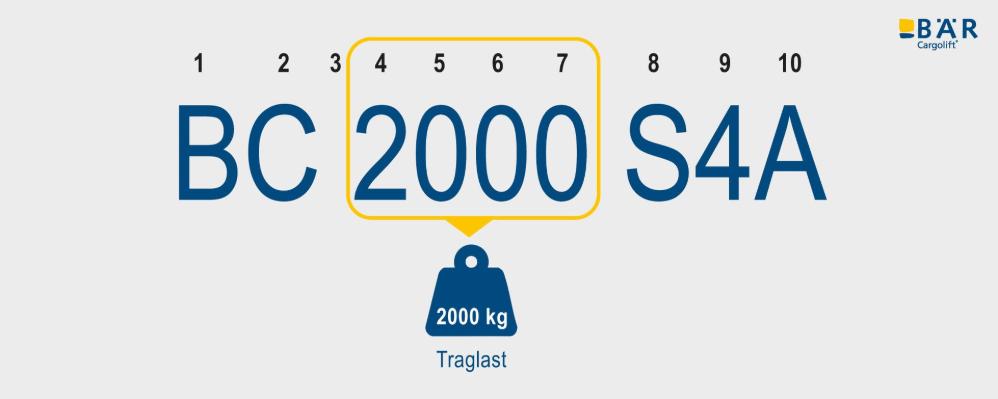
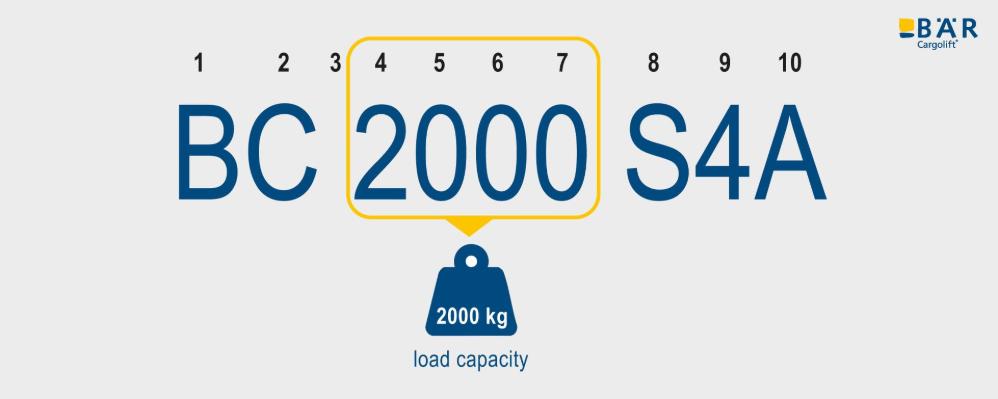
Position 4-7: 2000 - Load capacity
The numerical specification ‘2000’ indicates the load capacity or nominal load of the Cargolift in kilograms (kg). It indicates the maximum load for which the tail lift is designed. In the example, this is 2,000 kg.
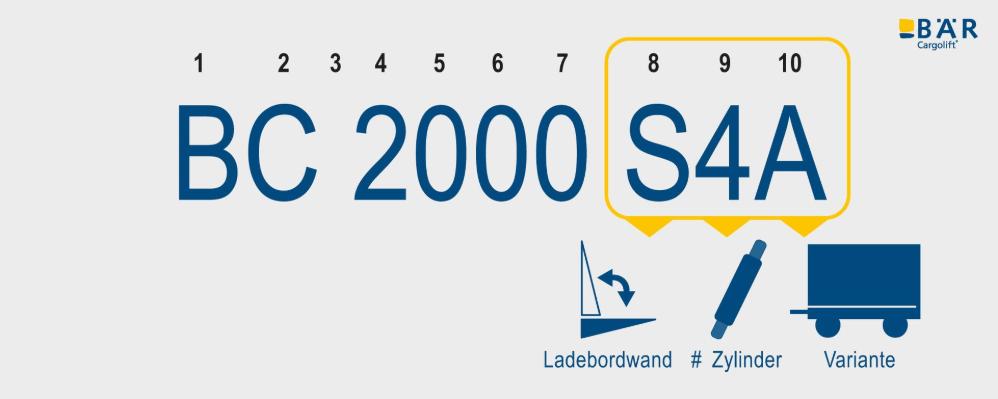
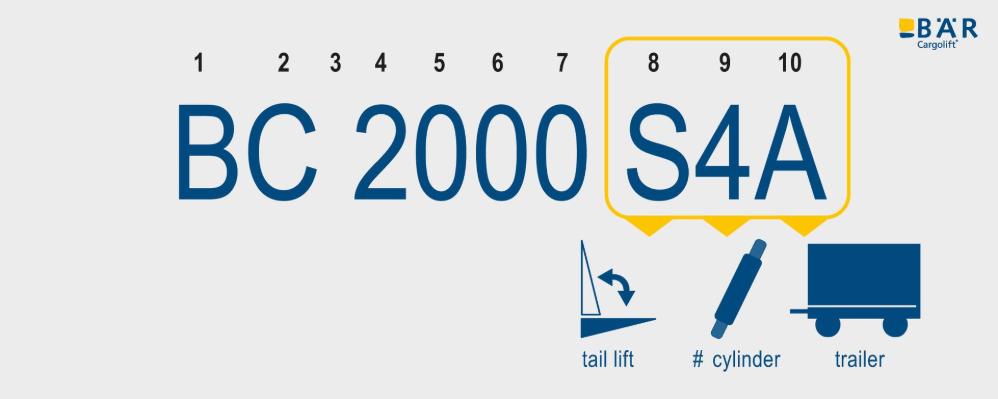
Position 8: S – Tail lift type
The letter ‘S’ indicates the tail lift type - the basic technology, so to speak. In the example, ‘S’ stands for Standard Cargolift, consequently a Cantilever lift with a wide platform positioned vertically behind the vehicle body.
BÄR makes a general distinction here:
A = FreeAccess Cargolift = the vertically folded platform is in the travelling position behind the vehicle
F = Falt Cargolift = the platform is folded in and out manually and is positioned under the vehicle
H = HydFalt Cargolift = the hydraulically folded platform is slided horizontally under the vehicle
R = RetFalt Cargolift = the manually folded platform is slided horizontally under the vehicle (retractable)
S = Standard Cargolift = the platform is positioned upright behind the vehicle body
Further information can be found in the lexicon articles Tail Lift Types Part I and Part II.
Position 9: 4 – Number of hydraulic cylinders
The number ‘4’ indicates the number of hydraulic cylinders installed in the lifting mechanism. In the example, there are a total of four cylinders – two lifting cylinders and two tilting cylinders.
Position 10: A – Technical feature
The letter ‘A’ indicates a technical or design feature. In the example, ‘A’ indicates the trailer version (in German 'Anhänger'). This lift is optimised for mounting on turntable trailers and can be mounted on a smaller body overhang (smaller installation space).

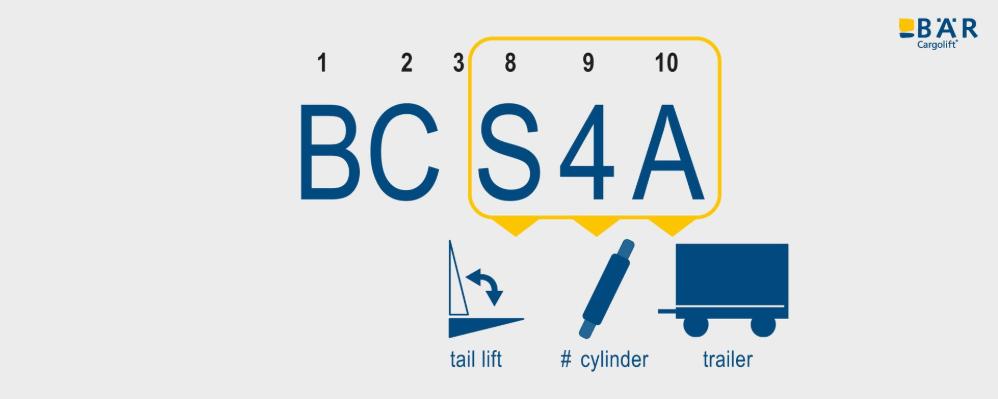
The essence of the product name: Positions 8-10 describe the Cargolift system
BÄR often uses positions 8 to 10 to refer to a Cargolift system. This is because the interpretation of position 10 is often linked to positions 8 and 9. In general, BÄR distinguishes between the following Cargolift models:
A2L = FreeAccess Cargolift with two hydraulic cylinders and platform on the left behind the tranporter body
A2V = FreeAccess VanLift with two hydraulic cylinders for panel vans
F2 = Falt Cargolift (tuck-away) with two hydraulic cylinders
F4 = Falt Cargolift (tuck-away) with four hydraulic cylinders
H42 = HydFalt Cargolift = with double hydraulic platform folding and four hydraulic cylinders
R21 = RetFalt Cargolift with single folded platform and two hydraulic cylinders for trucks
R2T = RetFalt Cargolift with single folded platform and two hydraulic cylinders for semi-trailers
R41 = RetFalt Cargolift with single folded platform and four hydraulic cylinders for trucks
R42 = RetFalt Cargolift = retractable with double, manual platform folding and four hydraulic cylinders
R4C = RetFalt Cargolift with single-folded platform and four hydraulic cylinders for steering axle semi-trailers (Compact)
R4K = RetFalt Cargolift with single-folded platform and four hydraulic cylinders for city semi-trailers (Compact = in German 'kompakt')
R4T = RetFalt Cargolift with single-folded platform and four hydraulic cylinders for semi-trailers
R4U = RetFalt Cargolift with single-folded platform and four hydraulic cylinders for trucks with low coupling (under-coupling)
S2 = Standard Cargolift with two hydraulic cylinders
S2L = Standard Cargolift with two hydraulic cylinders for van chassis - Lightweight, payload-optimised version
S2S = Standard Cargolift with two hydraulic cylinders for van chassis - strong, power-optimised version
S2V = Standard VanLift with two hydraulic cylinders for panel vans
S4 = Standard Cargolift with four hydraulic cylinders
S4A = Standard Cargolift with four hydraulic cylinders for trailers (in German 'Anhänger')
S4L = Standard Cargolift with four hydraulic cylinders - Light, payload-optimised version
S4T = Standard Cargolift with four hydraulic cylinders for semi-trailers with low coupling
S4U = Standard Cargolift with four hydraulic cylinders for trucks with low coupling (under-coupling))
S4V = Standard Cargolift with four hydraulic cylinders and variably positionable underride guard
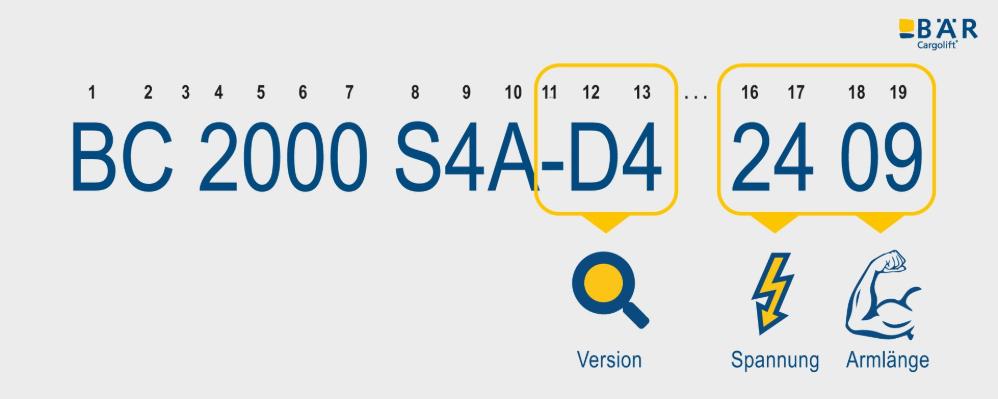

Position 11 and following - the product description continues
You guessed it - initially you will only see ten positions of the product name. However, there is more in the document download or in the order or service documents, whereby items 12 and 13 in particular, together with the Cargolift system (items 8-10), describe the specific version or development status of the Cargolift:
Position 11 = separator – there is always a hyphen here
Position 12 = model – each letter stands for a defined parallelogram
Position 13 = series – the number is increased in the event of significant changes
Position 16 + 17 = voltage in volts – usually 12 or 24
Position 18 + 19 = arm length in millimetres (mm), for example 07 for arm length 700 mm
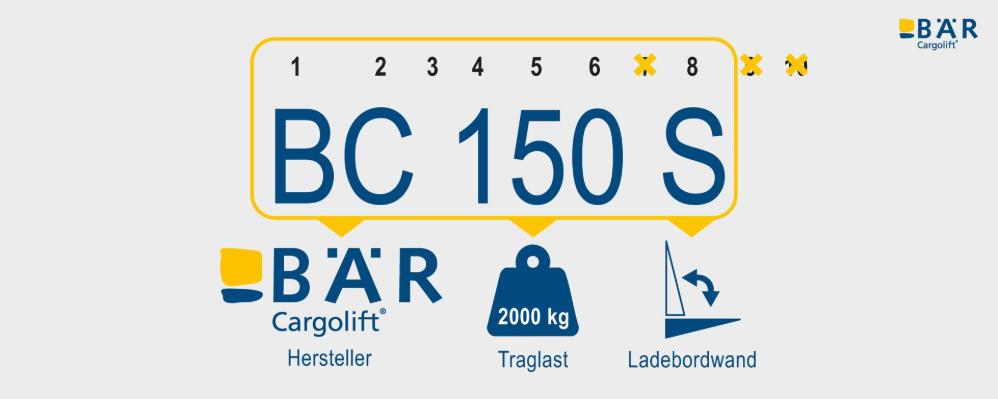
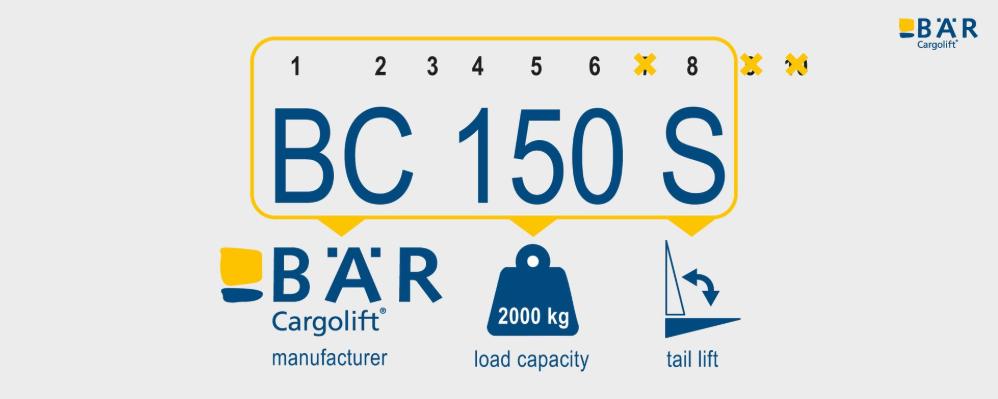
Special case: Product line Bär Cargolift Basic
Focused on the essentials - this is also reflected in the product name: BC 150 S.
In short, it is a Bär Cargolift Standard with a load capacity of 1,500 kg.
Summary & frequently asked questions (FAQ)
At BÄR, the product name has a system! You can decipher it as follows:
BC = Bär Cargolift (manufacturer)
2000 = Load capacity 2,000 kg
S = Standard Cargolift
4 = Number of hydraulic cylinders
A = Trailer (technical feature)
This structured designation enables quick, clear technical categorisation of the product and facilitates efficient communication between the manufacturer, sales department, body builder, service workshop and user.
Test your knowledge of the product name directly in the document download. There you will find fitment drawings, mounting instructions, certificates and operating instructions for the current product portfolio as well as brochures, dimension sheets and service documents.
Would you like to find out more? More encyclopaedia articles are in the pipeline! Stay interested!
The abbreviation "BC" serves as a unique manufacturer identification code that explicitly designates the product as an authentic Bar Cargolift product. This standardized prefix ensures clear brand attribution and error-free parts identification across the entire fleet management and workshop network. This systematic naming convention is a core feature found across all Bar Cargolift tail lifts.
When production originally began in 1981, the products utilized the abbreviation "LBW," which stood for "BÄR Ladebordwand." To establish a standardized, international product name with a clear system, the company officially transitioned to the global brand name utilized today in 1992. This long-standing engineering heritage defines the premium quality and reliability expected from modern Bar Cargolift tail lifts.
Workshop technicians can quickly identify the lift type, lifting capacity, hydraulic configuration, and application variant from the model designation alone. This accelerates diagnostics, spare parts identification, and service procedures for Bar Cargolift tail lifts.
A structured nomenclature allows technical decision-makers to instantly decode the exact specifications, cylinder configurations, and design types of a lifting system without needing to consult a separate data sheet. This clarity streamlines the vehicle manufacturing process, and minimizes configuration errors. A clear, logical naming system is a key operational advantage integrated into the documentation of all Bar Cargolift tail lifts.
Yes. The model code provides essential information about the tail lift's technical design and configuration. This helps spare parts dealers determine the correct components more efficiently and reduce ordering errors when supplying parts for Bar Cargolift tail lifts.